Algarve Property Market: Subdued Summer Sales and Slowing Price Growth
August 2026 at a glance: three market signals
- Agreed sales and buyer enquiries stay in negative territory
- House price growth has cooled steadily in recent months
- Rental market firms, with tenant demand rising and expectations for near-term activity positive
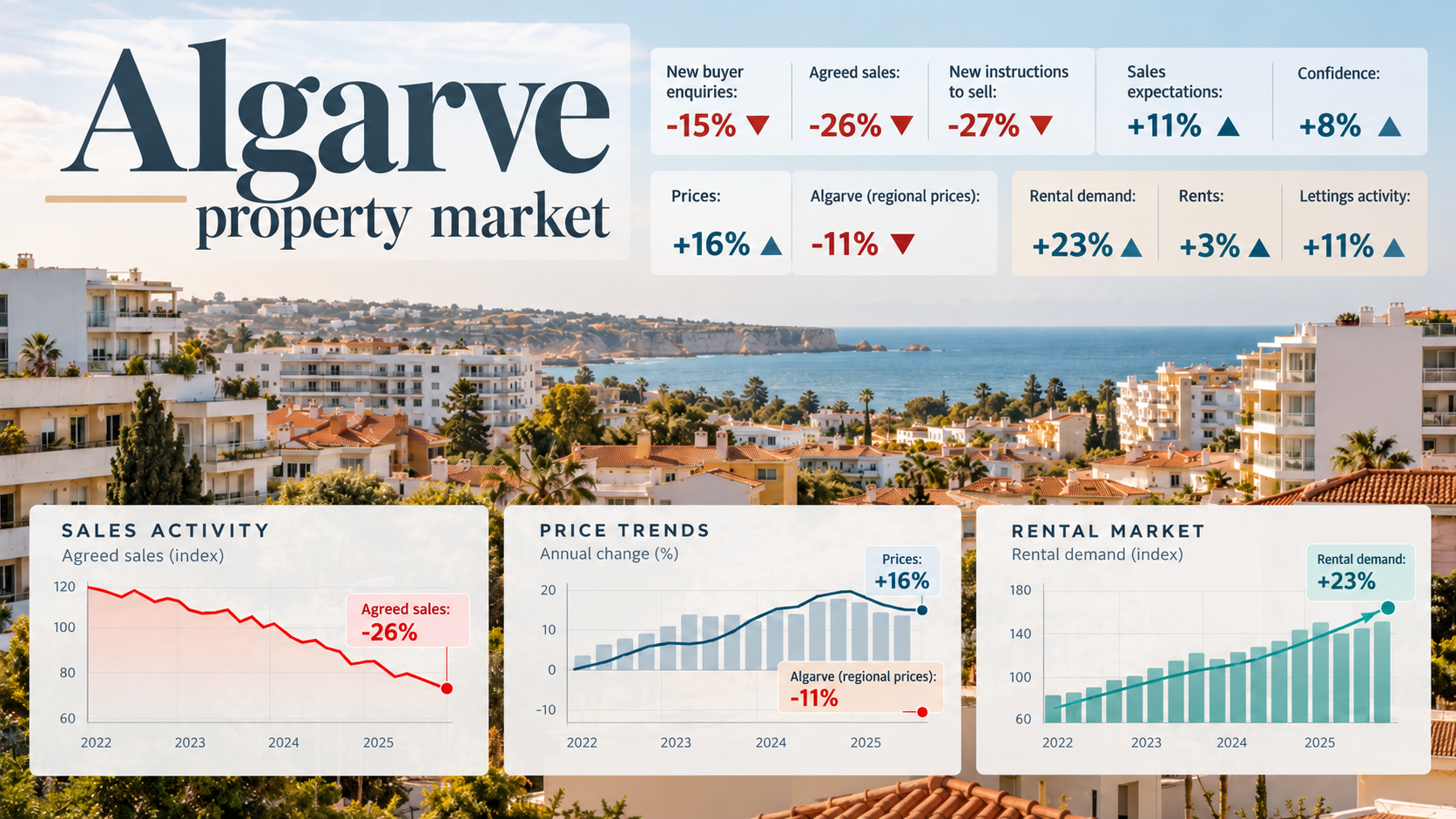
The August 2026 edition of the RICS/Ci PHMS depicts a sales market that has remained subdued through the summer months. Agreed sales and buyer enquiries both sit in negative territory, continuing a pattern that has been evident for much of the year, while house price growth, though still positive, has moderated steadily since the start of 2026. The lettings market, by contrast, presents a firmer picture, with tenant demand solidly positive although rents have remained largely flat.
House prices still rising, but at a slower pace
The buyer enquiries metric stands at a net balance of -15%, broadly in line with the average over the year so far and indicative of demand conditions across the sales market that have remained somewhat patchy rather than deteriorating sharply. Alongside this, the agreed sales series is a little more downbeat, returning a net balance of -26% in August, marking the softest reading of the year to date. New instructions to sell remained firmly negative at -27%, underlining the persistent shortage of stock that has characterised the market for some time. Forward-looking indicators are more stable, with near-term sales expectations at +11% and the confidence indicator at +8, suggesting respondents anticipate a slight improvement in the period ahead.
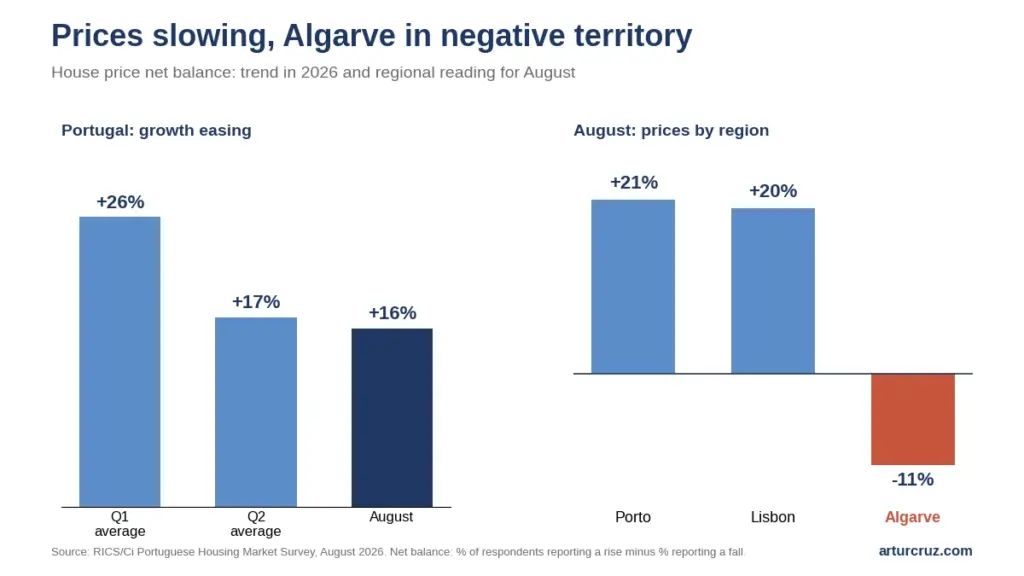
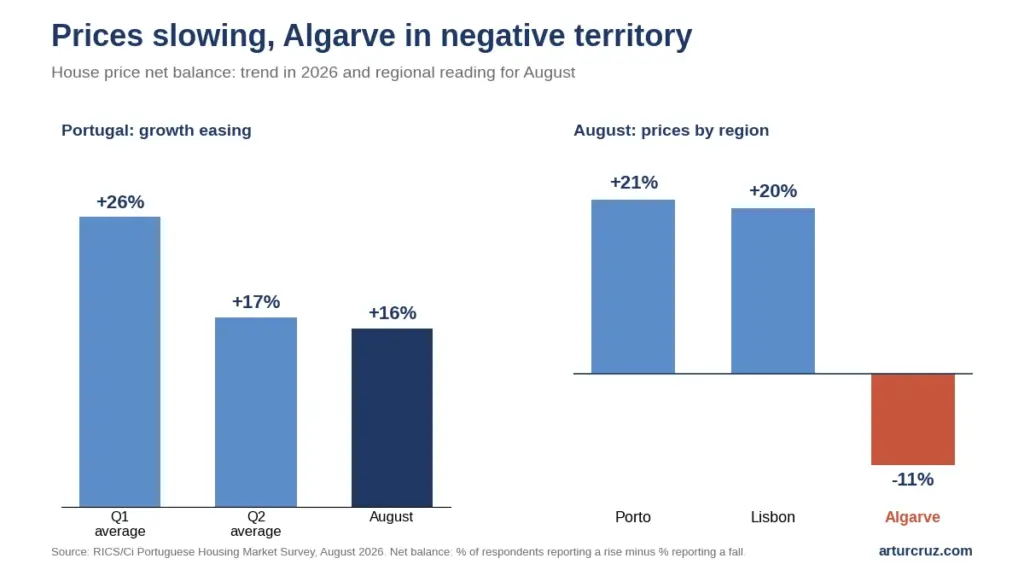
House prices continue to rise, with the national net balance at +16%. The clearer story, however, is the steady moderation in price growth over the course of the year. Indeed, the aggregate balance has eased from an average of around +26% in the first quarter to +17% in the second, and has held near this more moderate level through the summer. At the regional level, Porto and Lisbon remain the primary drivers of growth, with net balances of +21% and +20% respectively, while the Algarve continues to lag, posting -11%. Near-term price expectations were modestly positive at a net balance of +4%, consistent with a continued but increasingly measured pace of price growth.
Rental market gains strength
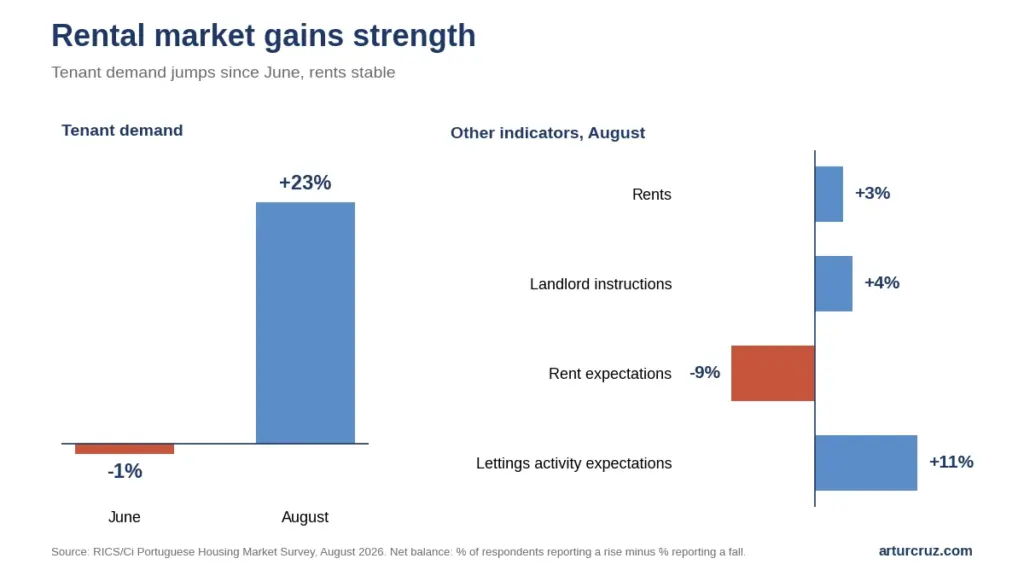
The lettings market presented a firmer picture in August. Tenant demand was solidly positive at +23%, which represents a noticeable strengthening in momentum relative to the flatter trend (net balance -1%) reported in June. Rents appear largely stable, with the net balance currently sitting in neutral territory at +3%. Meanwhile, landlord instructions were broadly flat at a net balance of +4%, a departure from the negative readings that had prevailed for much of the year and a tentative sign that rental supply constraints may be easing. Rental expectations remained negative at -9%, though lettings activity expectations turned positive at +11%.
Ricardo Guimarães, Director of Ci:
“The Portuguese housing market is facing a challenging period, primarily due to rising interest rates and ongoing international uncertainty. In the short term, these factors are being reflected in a slower market, with fewer transactions and more moderate price growth. In the recent past, however, prices and transaction volumes recovered quickly following the first signs of stabilisation in inflation and interest rates, leading many who had postponed planned purchases to feel they had made the wrong decision. This experience may encourage informed buyers and lenders to remain more resilient and active in the market going forward.”
Tarrant Parsons, Head of Market Analytics at RICS:
“Inflation has risen above 3% in recent months, driven largely by higher energy prices, and those pressures are likely to persist in the near term with the Strait of Hormuz still heavily restricted in terms of commercial traffic. The ECB has responded by raising its deposit rate to 2.5%, its second increase this year, marking a shift towards tighter policy that could gradually feed through to mortgage costs. Even so, the domestic fundamentals that matter most for housing remain supportive, with a resilient labour market, rising real incomes, and EU recovery funds continuing to underpin investment and demand.”
Source/Author: Confidencial Imobiliário (August 2026)